
Universal Gates may implement any Boolean function without using any other gate type. The NAND gate and NOR gate are called Universal gates because they can perform all the three essential functions of AND, OR and NOT gates.
A two-input NAND gate is a digital combination logic circuit that performs the logical inverse of an AND gate. While an AND gate outputs a logical “1” only if both inputs are logical “1,” a NAND gate outputs a logical “0” for this same combination of inputs. Here, we will explore the Universal gates, NAND Gate & NOR Gate, along with a few examples of each.
Table of content
Universal gates are those gates that can perform the tasks of other gates with minor adjustments. Universal gates are widely used in formulating NAT-based questions in the GATE exam. There are two universal gates:
Let us understand these universal gates in detail in the coming sections.
The NAND gate is one of the universal gates. The NAND gate is a AND gate followed by a NOT gate. Thus, we can say it is a AND NOT operation. It may have two or more inputs but only one output. The logical symbols of a NAND Gate and the truth table are shown below.

It is clear from the truth table of the two-input NAND gate that the output is 1 when either A or B or both the inputs are at logic ‘0’. We can say that if Ā = 1 = B are, both A and B are 1, and the output is 1. Therefore, the NAND gate can perform the OR function by inverting the inputs.
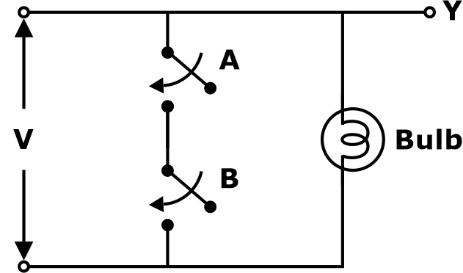
The bulb will glow when any of the switches A or B will open (logic 0).
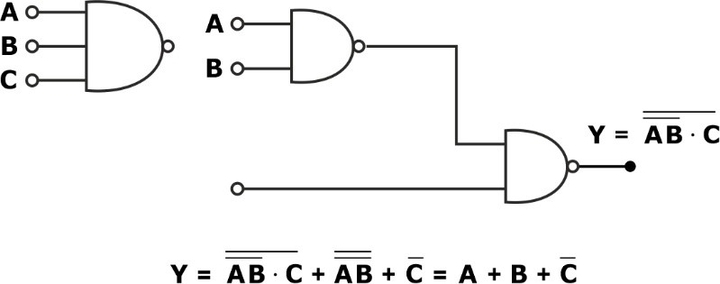
For a NAND Gate
